 Europe’s energy resilience and defense capability depend on batteries—yet almost the entire battery value chain sits outside Europe.
That was our strongest reflection after two days at the Civil-Military Innovation Program (CMIP) organized by Vinnova Sweden’s Innovation Agency and the Swedish Armed Forces.
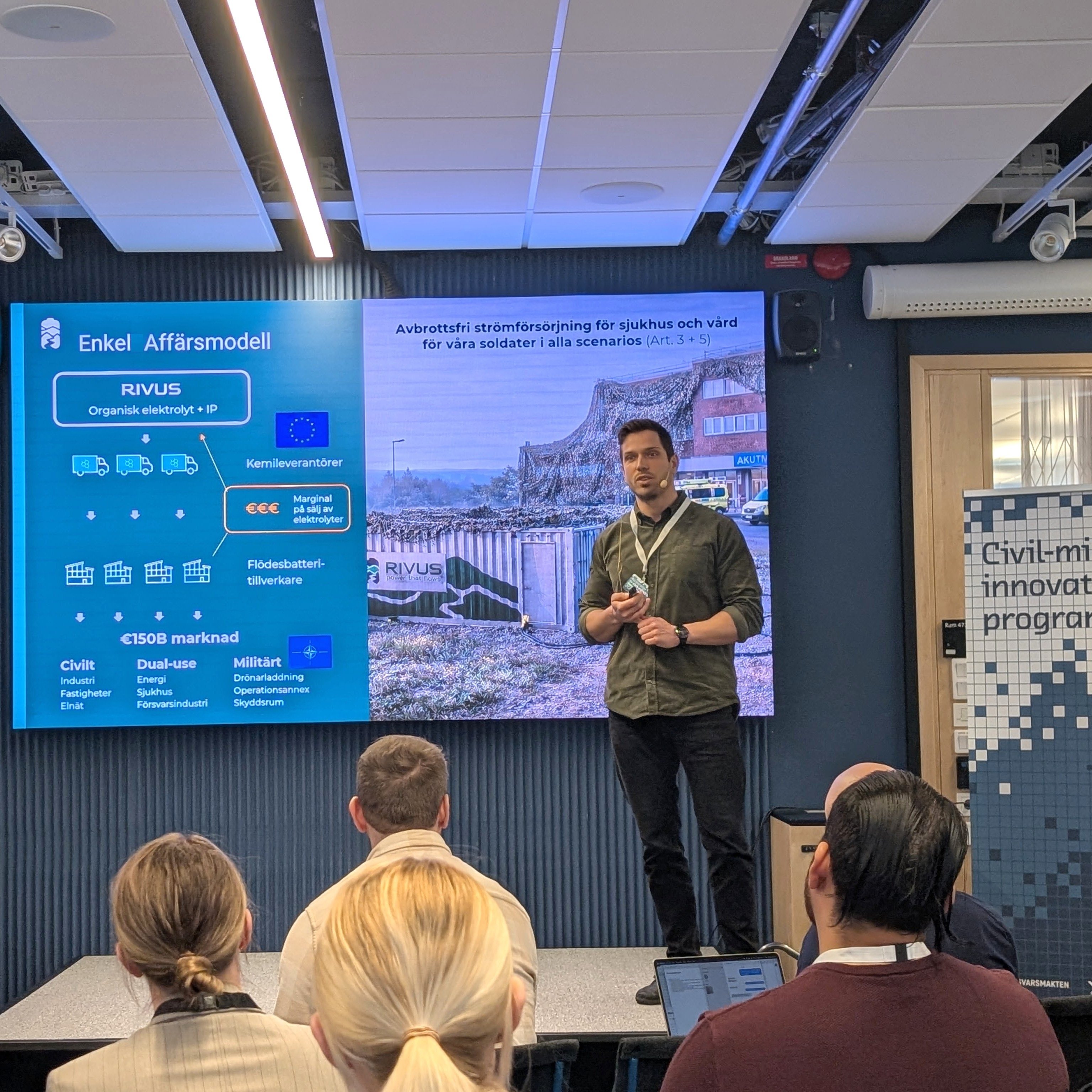
Alongside other Swedish startups, we had the opportunity to pitch Rivus Batteries to defense customers and investors, and engage with experts from the Swedish Armed Forces, FOI (Swedish Defence Research Agency) and FMV (Swedish Defence Materiel Administration). Key reflections from the discussions:
• In today’s geopolitical landscape, energy resilience is an existential issue for Sweden and Europe. Batteries power many critical societal and defense functions, and Europe simply cannot afford to repeat the strategic dependency it once had on Russian gas.
• Technological sovereignty and domestic manufacturing are at the top of the agenda. This is reinforced by policy initiatives such as EU’s upcoming New Industry Act which aims to boost EU's manufacturing share of GDP from 14% to 20%, Sweden’s Defence Industrial Strategy and increasing defense investments with NATO countries moving toward 5% of GDP in defense spending.
• Lessons from Ukraine clearly highlight the importance of decentralized energy systems. Daily Russian attacks on energy infrastructure show how vulnerable large, centralized systems can be during conflict, while distributed systems with local energy storage are significantly more robust.
• Rivus fits directly into this shift. By replacing just one component in flow batteries (the electrolyte) we enable stationary energy storage based on organic chemistry and abundant materials instead of far-away critical metals. With flow battery hardware already manufactured in Europe, we can enable a fully domestic value chain using existing chemical industry infrastructure rather than complex global supply chains or capital-intensive gigafactories.
With a resilient value chain and non-flammable properties, organic flow batteries are well positioned to support a range of defense-relevant applications, including drone charging infrastructure, resilient power for field hospitals and operational bases, and decentralized energy systems that must keep operating even when grid infrastructure is disrupted.
The intersection of energy resilience, technological sovereignty and domestic manufacturing is rapidly becoming a strategic priority for Europe—and energy storage will play a central role.