
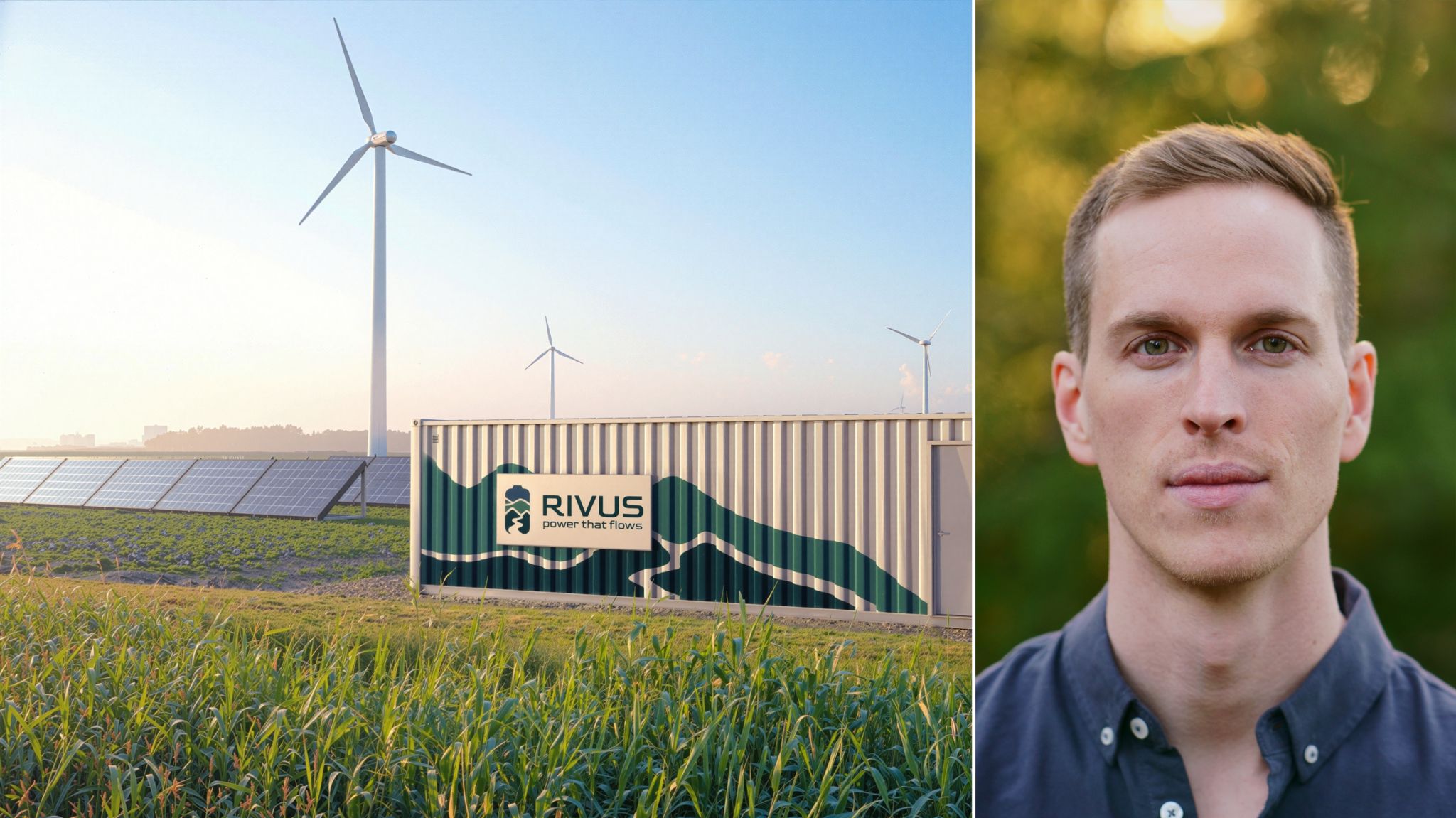
 We are grateful to Klimatledande Processindustri for their sharp piece on our work! 👇
It highlights how Rivus’ organic battery chemistry can enable a domestic, resilient energy storage value chain. As geopolitical volatility and energy disruptions persist, securing domestic energy independence has quickly moved from a strategic oppurtunity to a strategic imperative.
Original Article by Klimatledance Processindustri: Local raw materials pave the way for the future of sustainable energy storage 🔋 🌬️ ☀️
Through the CEROF project, the startup Rivus Batteries has investigated the possibility of replacing fossil raw materials with bio-based residual streams from industrial players in Western Sweden. The results show significant climate potential, although the path to a full-scale circular value chain requires both larger volumes and strategic investments.
To transition the energy system, efficient energy storage is required. Flow batteries, which use water-based electrolytes, can be a safer and more sustainable alternative to lithium-ion batteries for large-scale storage. Today, the technology is most often based on vanadium — a heavy metal that requires mining and is largely imported from outside Europe.
Gothenburg-based Rivus Batteries has developed a technology that instead is based on organic molecules. By using common bulk molecules from the process industry, a local value chain can be created and dependence on foreign mining can be reduced.
“One of the greatest advantages of our technology is the possibility of a very local value chain where we can break the dependence on mining, with major implications around the world,” says Cedrik Wiberg, CEO of Rivus Batteries.
Today, the raw material for Rivus’ molecules originates from coal. Although the carbon is not burned but bound in a battery with a 20-year lifetime, there is an ambition to achieve a fully fossil-free product. The CEROF project (Circular Electrolyte Raw Materials for Organic Flow Batteries) has therefore investigated whether bio-based pyrolysis oils from other members of the West Swedish Chemical and Materials Cluster can be used as raw material.
The result shows that the potential is significant: by switching to biomass-based raw material streams, greenhouse gas emissions can be reduced by between 40 and 70 percent, depending on the choice of material and method.
“We saw that the feedstock we need are present in pyrolysis oil from Western Swedish industry, but the volumes were too small for us to fully rely on it. However, even if we can only replace a share of our fossil raw materials with bio-based alternatives, it is clearly interesting for the future,” explains Cedrik Wiberg.
Project partners were: Rivus Batteries, BASF, CIT Renergy, Fortum, IVL Swedish Environmental Research Institute, Nouryon, Perstorp Group, Preem, and RISE Research Institutes of Sweden.
Link to full article (in Swedish): https://klimatledande.lindholmen.se/sv/nyheter/lokala-ravaror-banar-vag-framtidens-hallbara-energilagring