
One of the questions we’ve been asking ourselves from the beginning at Rivus is simple:
Can a battery chemistry built from abundant organic molecules also deliver a genuinely low environmental footprint?
To better understand this, we commissioned RISE Research Institutes of Sweden to conduct a Life Cycle Assessment (LCA), assessing our technology across a range of climate and environmental impact categories.
The study followed the ISO standard for lifecycle assessment. The functional unit was defined as one kWh of delivered energy over the battery’s lifetime, and the system boundaries followed a cradle-to-gate approach, including raw material extraction and processing, electrolyte manufacturing, system manufacturing and battery assembly. Use-phase losses, maintenance and end-of-life were not included at this initial stage.
And the results are encouraging.
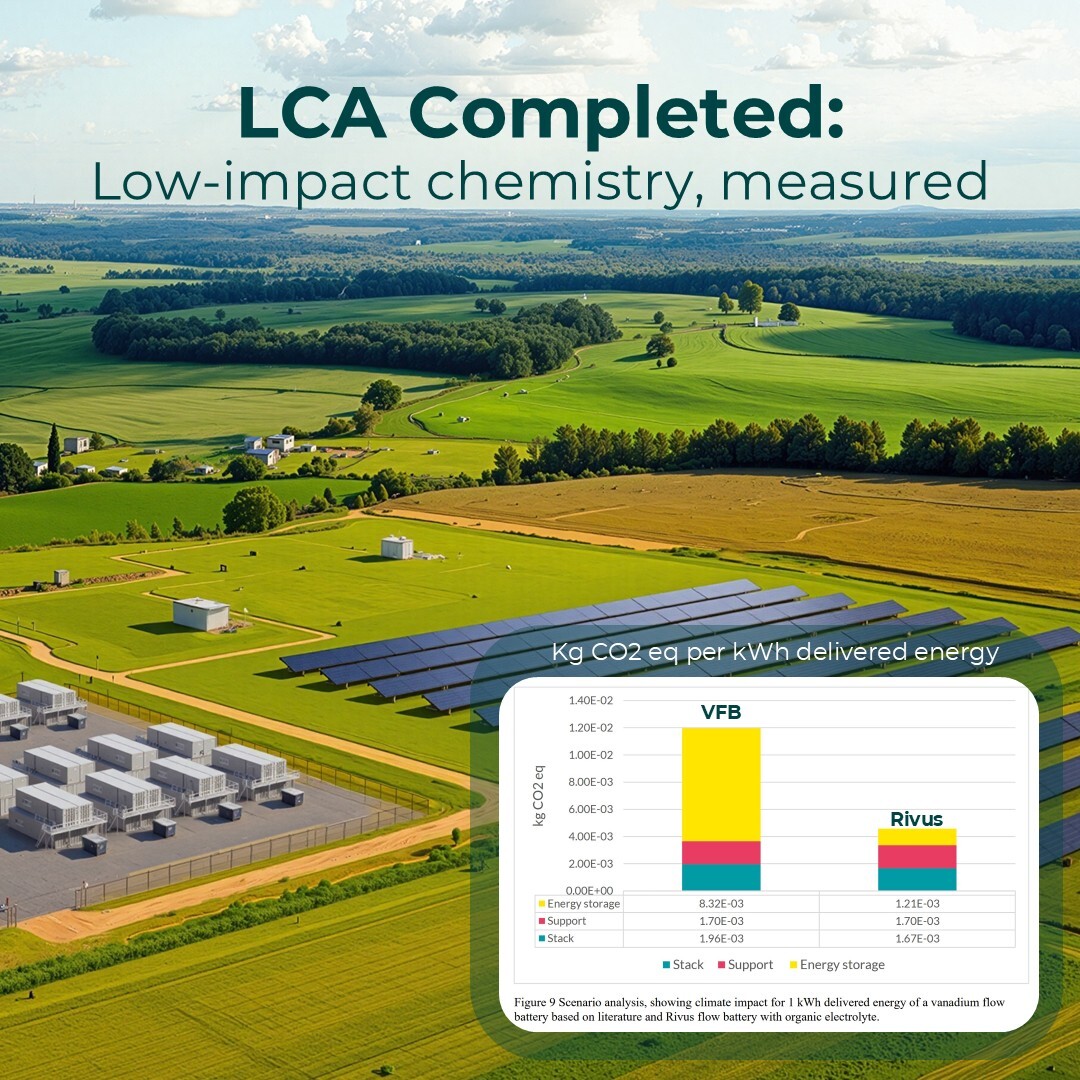
The analysis indicates a climate impact of 0.0046 kg CO₂e per kWh of delivered energy over the battery's lifetime with the climate impact, as well as the other assessed impact categories, being relatively evenly distributed between stack, support and energy storage categories - while for vanadium flow batteries the vanadium-based electrolytes are the single largest driver of the climate impact. Furthermore, the scenario analysis in the LCA indicates that Rivus’ organic flow battery system has the potential to achieve a lower environmental impact than a vanadium flow battery system based on literature data*.
Most importantly, the LCA has helped us identify where the largest environmental hotspots are in our system today. The analysis shows that the main opportunities for further improvement lie in electrolyte production, particularly solvent recycling and catalyst reuse - insights that are now directly guiding our R&D and development work.
As with any LCA of a technology not yet produced at industrial scale, these results include uncertainties. In particular, the vanadium flow battery benchmark is based on literature data, and parts of the electrolyte modelling rely on proxy and calculated data – where one strong advantage for vanadium electrolytes is that they can be indefinitely recycled. The assumptions and references used in this study will be refined as we move toward industrial production.
Rivus was founded on the idea that large-scale stationary energy storage should not have to depend on scarce metals or critical minerals. The results from our first LCA analysis strengthen our conviction that our organic flow battery technology - based on globally available feedstocks and scalable chemistry - can be an enabler of both a resilient, domestic supply chain as well as an inherently lower climate footprint for large-scale stationary energy storage.
A big thank you to and the team at RISE Research Institutes of Sweden for a thorough collaboration and insightful LCA report!
*Citation from the LCA report (page 32): "Data for the vanadium flow battery in the scenario analysis is taken from literature and quality would increase if primary data for such a battery was available. One particular source of uncertainty for modelling is extraction and production of vanadium pentoxide, for which environmental impact differ largely depending on which data source that is used for modelling. In this study, one of the data sources with lowest impact has been used, as an attempt not to overestimate the potential benefits of Rivus battery system".